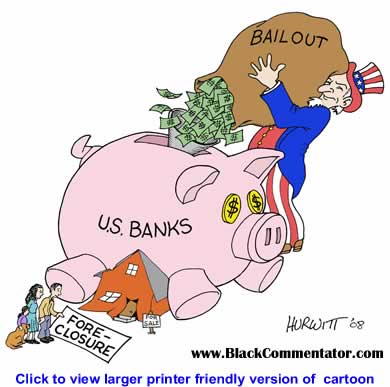
ZERO ACCOUNTABILITY! This is a charge that many of the bankers who work in finance have become comfortable with. 2008 is a year that will be remembered for the financial crisis that sparked what could possibly be the largest recession since the great depression. These bankers have watched while their clients have lost the majority of their portfolios. While their clients have been dealing with the repercussions of losing this money these bankers are still raking in the big bucks. Bankers and financial institutions are still taking bonuses and spending money to advance the institution. “79% of Wall Street workers who responded to a poll by eFinancialCareers.com said they received a bonus for 2008, despite the carnage.” One question that I’ve been pondering is, how can these bankers afford to take bonuses when all their clients are being hit by record losses? How can Citigroup afford a new plane when they are laying-off thousands of workers? The answer to this question is zero accountability. These bankers don’t care about their clients and the consumers because they will still get theirs at the end of the day. The success and money these bankers earn should directly correlate to money they make their clients. In order to fix the problem you must make it that these bankers depend on their clients and companies success to put food on the dinner table. This will help the economy cause instead of seeing each client as just another number they will see each client as a way to send their kid to college. If changes don’t occur to directly connect the bankers success to their clients the consumers will eventually lose faith in the financial industry and be unwilling to invest making it even harder for our economy to rebound from this recession.
Wednesday, February 4, 2009
Looting Stars
ZERO ACCOUNTABILITY! This is a charge that many of the bankers who work in finance have become comfortable with. 2008 is a year that will be remembered for the financial crisis that sparked what could possibly be the largest recession since the great depression. These bankers have watched while their clients have lost the majority of their portfolios. While their clients have been dealing with the repercussions of losing this money these bankers are still raking in the big bucks. Bankers and financial institutions are still taking bonuses and spending money to advance the institution. “79% of Wall Street workers who responded to a poll by eFinancialCareers.com said they received a bonus for 2008, despite the carnage.” One question that I’ve been pondering is, how can these bankers afford to take bonuses when all their clients are being hit by record losses? How can Citigroup afford a new plane when they are laying-off thousands of workers? The answer to this question is zero accountability. These bankers don’t care about their clients and the consumers because they will still get theirs at the end of the day. The success and money these bankers earn should directly correlate to money they make their clients. In order to fix the problem you must make it that these bankers depend on their clients and companies success to put food on the dinner table. This will help the economy cause instead of seeing each client as just another number they will see each client as a way to send their kid to college. If changes don’t occur to directly connect the bankers success to their clients the consumers will eventually lose faith in the financial industry and be unwilling to invest making it even harder for our economy to rebound from this recession.
Don't Become a Victim of Investment Schemes
This is a clip from the movie "Boiler Room" where Seth, an up-and-coming broker uses an inspiring, but untrue, sales pitch in order to land an unsuspecting client. I think the clip is pretty funny, but it shows just how easy it is to be influenced by the allure of easy money. As a consumer it is important not to fall into one of these traps.
10 Tips to Protect Your Money


Posted by: Andrew Moran
In today’s extremely volatile and unpredictable economy, many people are wondering how/if they will be able to manage their money wisely enough to retire. For many of these people, retirement funds, either savings or pensions, are the only sources of cash they have. In order to manage and protect these “nest eggs”, there are a few tips that can be extremely helpful.
- Incentives Matter
- Understand Your Investment Strategy
- Never Completely Trust Anyone With Your Money
- If It Looks Too Good To Be True, It Probably Is
- Put Yourself In Someone Else’s Shoes
- To Find Our Biggest Enemy, Look In the Mirror
- Never Feel Too Good About Your Investment Strategy
- Ignore The Experts
- We Are Not All Above Average
- Use Some Uncommon Common Sense
Many of these rules are fairly straight forward, but there are a few which deserve a little bit of explaining. In essence, these ten tips are some basic rules to abide by when dealing with investment. When it comes down to the bare bones of these ten tips, the main idea to take away is when you are about make a decision regarding and investment, you should step back and take some time to seek the opinion of some trusted family members, friends, co-workers, etc. These are the people who may be the key in deciding to invest or pass on a certain opportunity. These are also the people who may help you come up with some colorful ideas. Financial planners, analysts, etc. are great at what they do, but many of them have their own incentives and perks for doing business with your. They may not be entirely truthful all the time, and may in fact be investing your money in ways you do not know about, or do not want. In this regard, it is important that you understand exactly how you want you money invested, and where you want it invested. A sure fire way to lose all of your money is to try and get fancy with your investments and your investment strategy. According to the experts, it may be better to stick with the schoolyard principle KISS (Keep It Simple Stupid). This way, you will not confuse yourself, and will be well aware of what is going on with your money. A simple and effective strategy for maximizing your savings would include: maxing out a 401(k), opening nondeductible IRA’s, and opening a joint brokerage account. An investment strategy like this is simple and cost effective, exactly what a consumer needs.
If consumers are able to follow these rules when dealing with their investments, savings, etc. there is a much better chance for success. However, if you blindly trust a financial advisor with your money, or if you do not manage it properly, you could find yourself filing for bankruptcy or getting a visit IRS in the future.
Sources:
http://money.cnn.com/2009/01/13/pf/Ask_the_mole.moneymag/index.htm?postversion=2009012806
http://money.cnn.com/2009/02/04/pf/saving/toptips_costcutting_willis/index.htm
Consumer Finance Scams

This article pertains to a range consumer finance scams which are prevalent in the United States and what the Federal Trade Commission (FTC) is doing to combat these problems. Consumers who face financial troubles, such as heavy debt, poor credit, or the need for substantial help for educational or personal finances, usually can least absorb the economic injury caused by fraud. Yet these fraudulent companies continue to take millions from consumers without providing any services.
Click to Read More
Time to Buy Your Dream Car
By Alcides Hoy Jr.
With our economy in a recession it seems all industries are suffering, including the auto industry. Now might be just the right time to capitalize on the major deals that car companies and rental companies are offering. Once big time companies Toyota, GMC, and Ford are falling nearly fifty percent below their last years sales mark. If you are interested in having in those big trucks GMC is in a position where they are going to try there best to accommodate the price you are trying to work with. I read this one article and they showed a picture of a Ford car dealer lot. Just nearly all of their 2008 and some of 2009 cars are already on sale. If I didnt have a car I would look to companies such as Toyota who in the last year havent been able to compete with european companies within their market. So right now if you looking to buy a car go down to one of these companies dealers and give them your lowest price first.
Sources:
http://money.cnn.com/2009/02/03/news/companies/auto_sales/index.htm
http://www.foxnews.com/story/0,2933,232068,00.html
http://www.freep.com/article/20090203/BUSINESS01/90203051/0/BUSINESS06
Credit Repair Yourself
by Lionel CreechAs Americans push their credit to the limit, scams in all shapes and sizes appear to take advantage of the weak and desperate. In any case, if it sounds ‘too good to be true’, then it probably is. Credit repair is an area where legitimate and illegitimate companies exist. Many firms try to help consumers repair their credit through consultation and cooperation. Credit repair also involves a consumer’s right to dispute their credit history through the credit bureau. If inaccuracies are found, the consumer is entitled to adjustments yet accurate reports will remain in the credit score for 7 years and 10 years for bankruptcies. Thousands of fraudulent credit repair companies exist who claim that if your credit report isn’t 100% accurate, you are entitled to a clean slate. If this were the case, I believe we’d all jump on that opportunity. In any case, you can plead your case to the credit bureau for inaccuracies without the help of these firms. Another technique used is file segregation which uses your employee identification number (EIN) from the IRS and use it to build fresh credit. However good it sounds, it is officially a felony. Congress has taken steps to combat fraudulent firms with the Credit Repair Organizations Act (CROA) which provides information to consumers and attempts to shutdown illegal credit repair firms. Complaints against credit repair companies have risen for three straight years, increasing more than 38% since 2004 according to the Better Business Bureau. A few simple rules apply when looking at these credit repair companies. First, anything a credit repair firm can do for you (legally) is something you can do yourself – for free. Know your rights and make sure that legal documents are provided to you, especially their consumer rights document. Listen for fraudulent behavior such as “only talk to us”, file segregation, paying upfront fees, and piggybacking are a few major problems. Piggybacking means you can “ride” on someone else’s credit. Finally all you have to do is check out if the company is legitimate. Check out Consumer Credit Counseling Services and visit www.nfcc.org.
http://www.ftc.gov/reports/Fraud/finance.shtm
http://money.cnn.com/2008/02/18/pf/saving/toptips/index.htm
http://www.creditcards.com/credit-card-news/credit-resellers-services-1265.php
Tuesday, February 3, 2009
How knowledgeable is the consumer when it comes to their finances?
Posted by C Brown
Consumer loans, credit cards, and credit score are on a lot of peoples' minds today. Do you know how much you really owe creditors? Do you know how to monitor your credit reports? Can you keep track of your personal finances and do you know how to read and understand everything that your creditors are giving you? A lot of people would answer no to these questions. Too many people don't have enough knowledge about their personal finances. Many consumers are defaulting on loans or taking out second mortgages to keep their houses. Many people are talking to debt consolidators to help them get a handle on debt. This seems like a great idea because creditors stop calling and bills stop coming every day, but in all actuality, you are still paying creditors less than their minimum payment, which means they are still reporting that you are paying your loans back late which really hurts your credit score. Loans were meant to help people, but now all loans and credit cards have done for people is get them into financial trouble that they can't get out of. More homes are being foreclosed on. More people are losing their job because of the economic crisis, which makes it ten times harder for people to pay back loans and harder for banks to loan people more money. Now is also the best time for Cyber crooks and identity thefts. There has been more complaints in 2008 during the economic crisis of bank account fraud. There has been thousands of emails and now even text messages sent out to mainly corporate executives or people who are financially stable in order to steal personal information whether it is to take $10 or $40 out of their account. Since these emails are personally addressed to these financially stable people, they open them and it sets a virus in their computer giving the thief the opportunity to retrieve vital information about financial markets even before the information is released to the public. Consumers need to read and be knowledgeable of what is happening in our economy, and how our economy directly affects the consumer.
http://www.articlesbase.com/finance-articles/how-does-consumer-debt-counseling-services-affect-my-credit-score-675369.html
http://www.iht.com/articles/2008/04/21/business/21cndbank.php#top
http://online.wsj.com/article/SB123318475748226305.html
Save, Save, Save
by D. Babbs
In the midst of a market meltdown and economic crisis, many Americans' 401(k) retirement plans are looking a bit bedraggled. But some tender loving care from plan participants, employers and policy makers can help spruce up these accounts.
Market upheaval has underscored a litany of woes in 401(k) plans. Many people don't save enough, make poor investment choices, pay high fees that eat into returns, and raid their retirement accounts to pay credit-card bills or fight foreclosure. Meanwhile, hard-hit employers are suspending 401(k) matching contributions.
Monday, February 2, 2009
The Right Investment Strategy
For those people who have managed to keep their jobs, the biggest problem they now face is how to keep their retirement money in tax-free investments. Besides the usual 401k’s and tax deductible IRA’s there are a few other strategies you can use if your income is too high to be able to invest in these tax deferred investments. Some of these other options include; Nondeductible IRA, Health Savings Account, as well as some well placed taxable accounts. The strategy in these taxable accounts is to know the tax rates on your investments, and to set your money up as to minimize the tax consequences.
When it comes to investing your money, there are many different strategies to consider. One of these strategies is to diversify your portfolio. There are many pros and cons to this type of investing. Diversification will not guarantee you the highest possible return. In fact, you are guaranteeing that you wont get the best return. Diversifying also doesn’t guarantee you that you wont lose money. What diversification does give you is a chance for high returns while also limiting your losses. For example, stocks and bonds offer the chance for greater income but have more risk. Instead if you invested in a mix of secure and risky assets, you still had the chance of earning a nice return however, you can reduce the risk of a big loss. In this recent downturn in the stock market, those people who had invested in all stocks lost far more than people who had a more diversified portfolio. The key is to have the right mix that is good for your investment strategy.
References:
http://money.cnn.com/2009/01/26/pf/expert/diversification.moneymag/index.htm?postversion=2009012817
Don't Push Banks to Make Bad Loans, Contrary to myth, commercial bank lending is up. So are standards.
There is a widespread belief that banks are now refusing to lend as much as they should, and that Congress should pressure them to extend more credit to consumers and businesses.
In reality, banks as a whole increased their lending during 2008 -- the notion they haven't is based on a misunderstanding of U.S. credit markets. Pressuring banks to lend more could backfire.
Lost in too many discussions of the financial sector is that banks and other depository institutions account for only 22% of the credit supplied to the U.S. economy (down from 40% in 1982). "Shadow banking" -- notably asset securitization and money-market mutual funds -- now supplies 33% (up from 14%). Insurance companies, other financial intermediaries, nonfinancial firms and the rest of the world provide the balance.
As far as commercial banks go, Federal Reserve data released last week show that their lending increased 2.36% during the last quarter of 2008. For all of 2008, commercial-bank lending rose by $386 billion, or 5.63%, even as the economy slid into recession. Over that 12-month period, business lending jumped $152 billion, or 10.6%, real-estate loans were up $213 billion, or 5.9%, and consumer lending rose $73.5 billion, or 9%. Other categories of bank lending such as loans to farmers, broker-dealers and governments, declined $53.2 billion, or 5.4%.
Sunday, February 1, 2009
Let's Talk Auto Insurance
by D. Babbs
Last year, my godfather offered to give me his old car when his wife purchased a new jeep. I thought that idea was wonderful but then again, I thought about paying for car insurance. I knew I could not afford any other college expenses. Being that young adults are seen as more risky, I knew my rate would be sky high. So I began to look into affordable car insurance for people like me, broke, college students. The following list is some tips when looking into auto insurance:
Research, Research, Research – There are several insurance companies, so do your research. Understanding the prices and benefits of each company before you make a decision is crucial and can save you hundreds of dollars. Don’t be afraid to call each company and compare options.
Ask Around – Besides doing your own research, ask those you know with car insurance. They know first-hand the pros and cons of insurance companies. They can tell you what types of coverage to have and what to look out for when dealing with these companies.
Be A Good Student – Several insurance companies offer discounts to students, especially if full-time, who have at least a “B” average. With all the expenses that college incurs, who wouldn’t want to save money just by getting good grades.
Know Your Credit Score – One’s credit score will definitely have an impact on the policies that companies will offer. Companies use credit information to price policies. Make sure to pay bills on time, keep balances low, and check credit scores regularly.
Think About Higher Deductibles – Deductibles are what you pay before your insurance policy kicks in. Having a higher deductible can save money.
Use Mom And Dad – If possible, continue to use your parent’s insurance. Getting your own policy will put you in a higher risk pool and result in higher costs. (Risk requires compensation). Using your parents insurance and listing yourself as a secondary driver on a car will keep more money in your pockets.
Overall, choosing car insurance is a very long process, just like applying for college. Although I did not get my godfather’s car, I now have more knowledge when deciding what type insurance to purchase if I ever get a car.
http://www.pueblo.gsa.gov/cic_text/cars/autoinsu/autoinsu.htm
http://www.youngmoney.com/wheels/auto_insurance/030127_03
http://campuslife.suite101.com/article.cfm/insurance_for_college_students
Fed OK's Credit Card Crackdown
By: Corey Mutterperl
NEW YORK (CNNMoney.com) -- Cash-strapped consumers got some welcome news on Thursday when regulators voted to rein in controversial credit card practices. But they'll have to wait another year and a half to get relief -the new rules won't take effect until July 1, 2010.
The Federal Reserve Board, the Office of Thrift Supervision and the National Credit Union Administration approved the regulation, which prohibits banks from certain practices like applying interest payments in ways that maximize penalties, and forces lenders to be more transparent about their billing practices. "These protections will allow consumers to access credit on terms that are fair and more easily understood," Federal Reserve Chairman Ben Bernanke said in a statement.